
Certifications Can Open Doors. Practical Skills Help You Walk Through Them.
A practical guide to what employers look for beyond technical certifications—and how to demonstrate your abilities with credible evidence.
By Isaac Danso-Gyan (Coach Ike) · IT Career Coach, Network & Security Consultant, Author
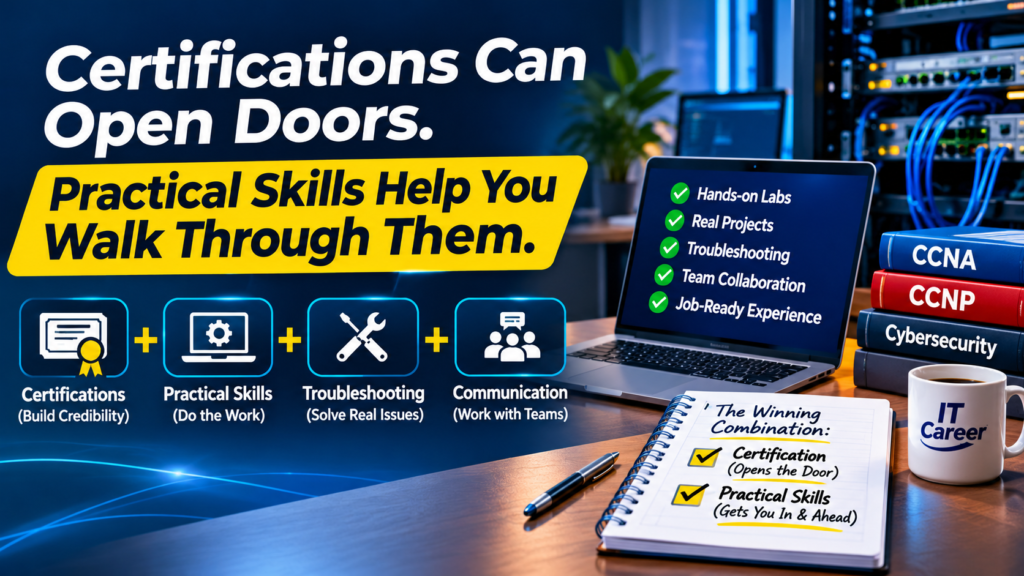
The certification is a starting point—not the finish line
An IT certification can show that you studied a defined body of knowledge and passed an assessment. That matters: structured learning can help you understand terminology, technologies, and recommended practices. But employers also need to know what you can do when a network fails, a user cannot connect, or a security rule interrupts legitimate traffic.
The strongest entry-level candidates connect their knowledge to observable work: they can explain a technical decision, demonstrate a configuration, investigate a fault methodically, and communicate the result. You do not need years of paid experience to begin building that evidence—but you do need to be accurate about what you have actually done.
1. Demonstrate hands-on technical ability
Choose a small set of practical tasks that align with the role you want. A network-support candidate might configure VLANs, verify inter-VLAN routing, inspect interface status, and troubleshoot an incorrect default gateway. A security-focused candidate might explain firewall policy order, test allowed and denied traffic, and interpret logs.
For each lab, document the starting problem, your topology or environment, the commands or tools you used, and the outcome. Screenshots alone are not enough; explain why each step mattered.
- Build a simple network with two or three VLANs and verify connectivity.
- Break one configuration deliberately, then troubleshoot it using a repeatable process.
- Record sanitized outputs such as
show ip interface brief,show vlan brief, and relevant ping or traceroute results. - Write a short summary: problem → investigation → fix → verification.
2. Show how you troubleshoot—not just what you memorize
Interviewers often care more about your reasoning than a perfect first guess. Start by clarifying the symptom and scope: Is the issue affecting one user, one subnet, or an entire site? What changed recently? What still works?
Then test from simple to complex. Check physical connectivity, addressing, DNS, routing, security policy, and application behavior as appropriate. State what each test proves or rules out. If you do not know a command, explain how you would verify it rather than pretending.
- Clarify the problem and its business impact.
- Form a hypothesis and choose a low-risk test.
- Observe the result and adjust the hypothesis.
- Apply an authorized fix and confirm service is restored.
- Document the root cause, resolution, and prevention steps.
3. Communicate technical work in plain language
A strong technician can speak to both engineers and nontechnical colleagues. When a service is unavailable, a user may not need a lecture about routing protocols. They need to know what is affected, what you are checking, and when they can expect the next update.
Practice explaining one lab twice: first to a technical peer using precise terms, then to a nontechnical manager using a brief impact-and-resolution summary. Good communication is a skill you can demonstrate in an interview.
4. Build a small portfolio of credible projects
A portfolio does not need to be elaborate. Three well-documented projects are often more useful than a long list of technologies you cannot explain. Organize each project around a real task, the tools used, the decisions made, and verifiable results.
Keep customer information, credentials, internal IP addressing, and proprietary configurations out of anything you publish. If a project was completed in a simulator or home lab, label it clearly as a lab—not production employment.
- Network segmentation: create VLANs and document how traffic moves between them.
- Network troubleshooting: diagnose an intentionally broken routing or DNS scenario.
- Security policy: create a sample firewall rule set and explain permitted versus blocked flows.
5. Write an honest, evidence-based technical résumé
Your résumé should distinguish certifications earned, certifications in progress, training projects, volunteer work, and paid experience. A recruiter should be able to see exactly where you applied a skill and what result you achieved.
For example, “Configured inter-VLAN routing for three simulated departments and verified connectivity using ping and switch/router show commands” is more informative than “Knowledge of networking.” Use wording that matches your real work and the job description; do not present a lab as a live business deployment.
- List certifications as earned only after passing the required exam or meeting the credential requirements.
- Use “Preparing for CCNA” or “CCNA studies in progress” when that is accurate.
- Include relevant projects with tools, scope, and results.
- Keep formatting clear so applicant tracking systems and people can read it.
6. Prepare for interviews with evidence and examples
Prepare a short explanation for each project: what problem you were solving, how you approached it, which alternatives you considered, and what you learned. Expect follow-up questions. If you say you configured OSPF, be ready to explain neighbor formation, route selection basics, and how you verified adjacency.
Use a simple structure for behavioral questions: situation, task, action, and result. For technical questions, describe the checks you would perform in order. Be candid about unfamiliar technology and explain how you would investigate safely.
A practical 30-day action plan
Week 1 — Choose your target role. Review five real job descriptions for entry-level network support, help desk, or junior security positions. Identify recurring skills and tools.
Week 2 — Complete a focused lab. Build a small environment and capture your topology, configuration steps, and verification results.
Week 3 — Troubleshoot and document. Introduce a fault, record your troubleshooting sequence, and write a one-page project case study.
Week 4 — Present your evidence. Update your résumé and LinkedIn profile, rehearse two project explanations, and ask a peer or mentor to challenge your reasoning.
What employers may evaluate beyond certifications
The exact requirements vary by role, employer, and experience level. In many technical interviews, however, candidates can expect questions about applied fundamentals, troubleshooting habits, communication, documentation, teamwork, and willingness to learn. A certification can help you reach the conversation; evidence of applied skills helps you contribute meaningfully once you are there.
Frequently asked questions
Can I get an IT job without a certification? Some employers hire candidates without certifications, especially when they have relevant experience, strong fundamentals, and demonstrable skills. Other employers require particular credentials. Check the roles you are targeting.
Are home labs and simulations worth including? Yes, when relevant and honestly labeled. Explain what you configured, how you tested it, and what you learned.
How many projects should I show? Start with two or three strong, clearly documented examples rather than many shallow ones.
What if I have no professional IT experience? Build foundational knowledge, complete realistic projects, seek legitimate opportunities to practice, and target roles aligned with your current skill level.
Turn what you know into what you can demonstrate
At Network Professional Training Center (NPTC), practical learning, labs, mentorship, and career preparation are central to the training approach. If you are exploring an IT career or preparing for your next technical role, start with a plan that connects learning to real skills.
About the author
Isaac Danso-Gyan (Coach Ike) is an IT Career Coach, Network & Security Consultant, author, and founder of Network Professional Training Center. His work focuses on helping learners turn technical knowledge into practical capability and career opportunity.